GLOBAL
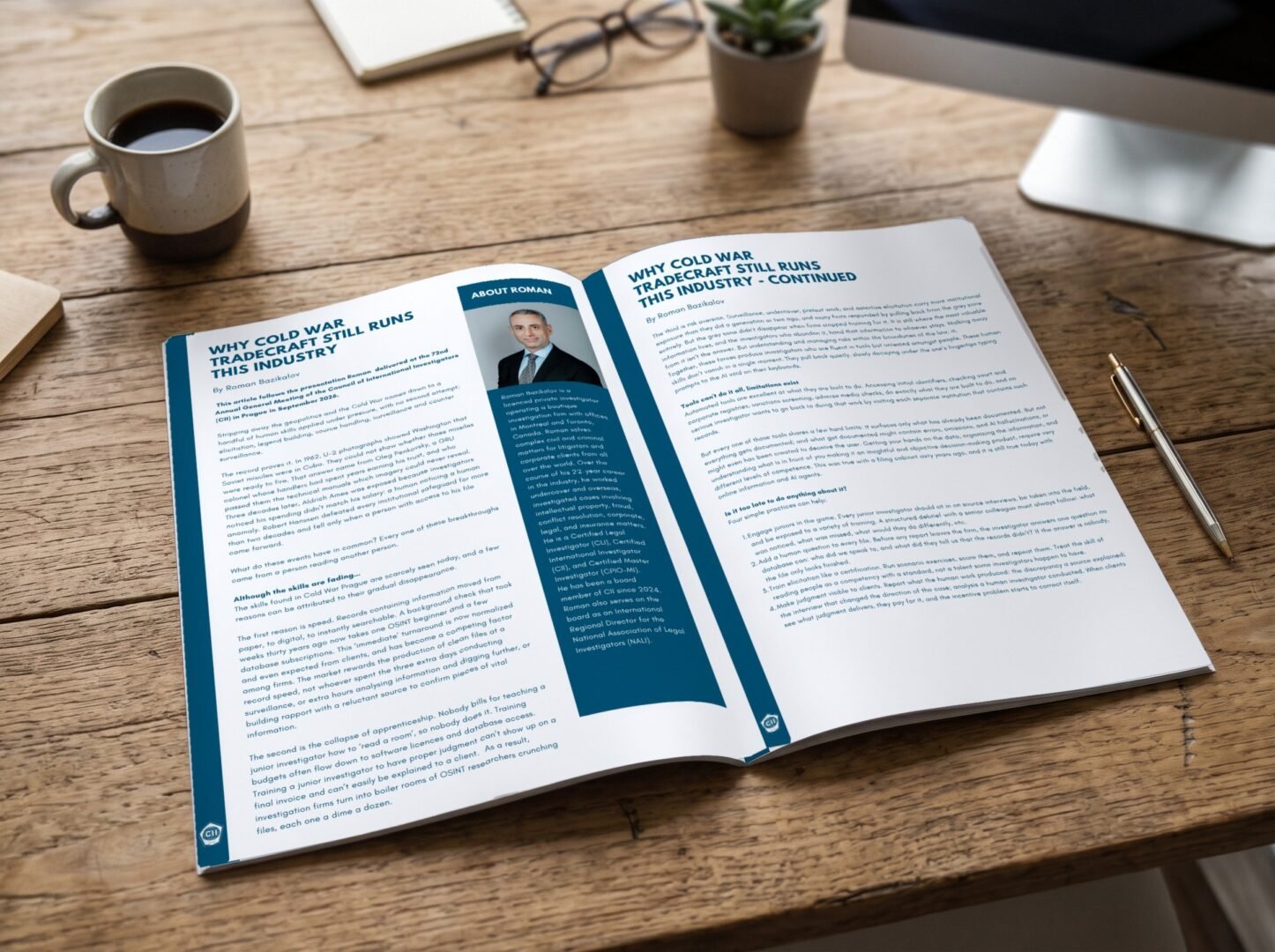
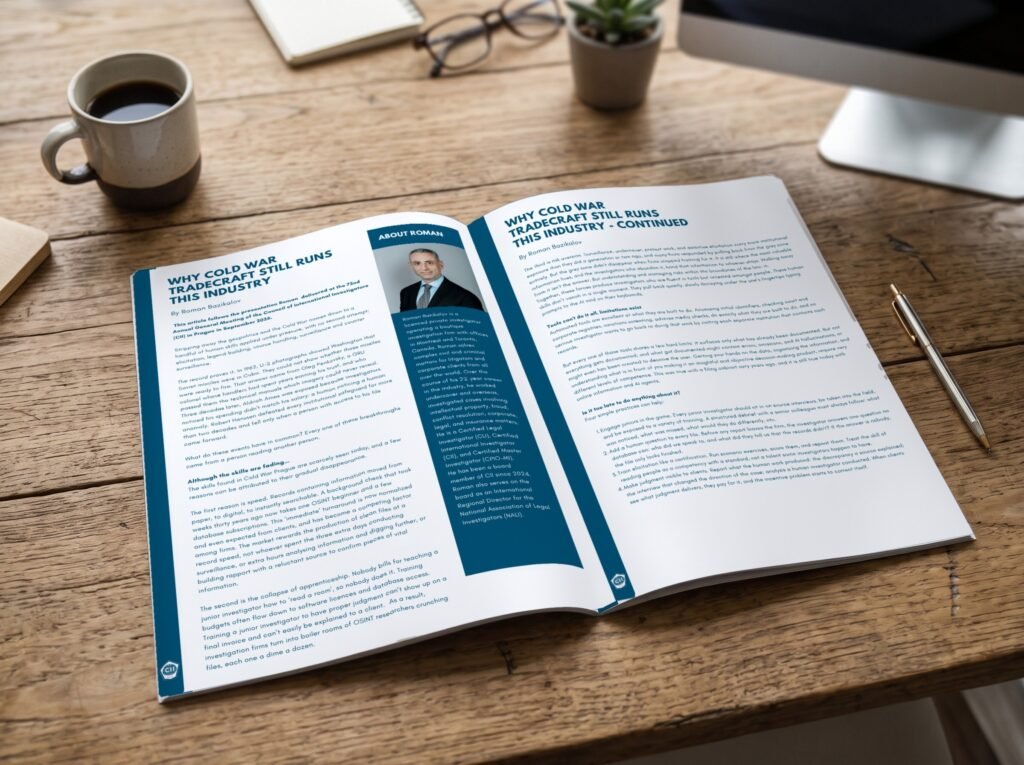
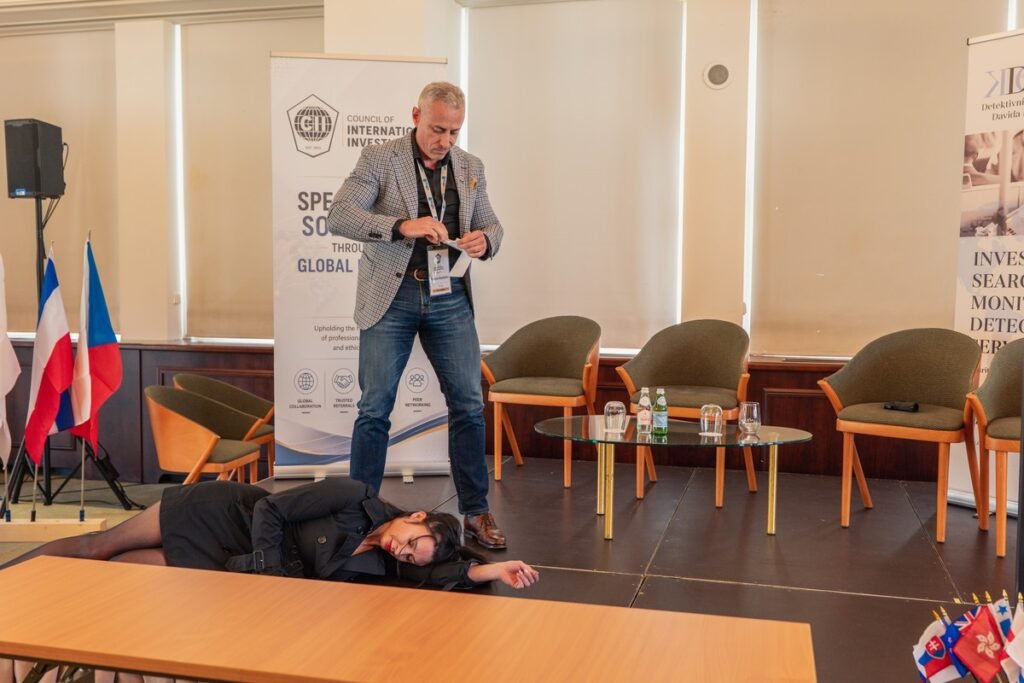
Our president, Roman Bazikalov, has been published in the October 2026 issue of The Councilor, the official newsletter of the Council of International Investigators (CII). The article grew out of the talk he gave at CII’s 72nd Annual General Meeting in Prague in September, a city where Cold War tradecraft was once practised on every street corner. Here is his argument, adapted for those who hire investigators.
Strip away the geopolitics
Strip away the geopolitics and the Cold War comes down to a handful of human skills applied under pressure, with no second attempt: elicitation, legend building, source handling, surveillance and counter-surveillance.
The record proves it. In 1962, U-2 photographs showed Washington that Soviet missiles were in Cuba. They could not show whether those missiles were ready to fire. That answer came from Oleg Penkovsky, a GRU colonel whose handlers had spent years earning his trust, and who passed them the technical manuals no imagery could reveal. Three decades later, Aldrich Ames was exposed because investigators noticed that his spending didn’t match his salary: a human noticing a human anomaly. Robert Hanssen defeated every institutional safeguard for more than two decades, and fell only when Eric O’Neill personally ‘worked’ him and noticed discrepancies.
Every one of these breakthroughs came from a person reading another person.
Why those skills are fading
Three forces are pushing them out of the profession.
- Speed. Records moved from paper to digital to instantly searchable. A background check that took weeks thirty years ago now takes one OSINT beginner and a few database subscriptions. Clients have come to expect that turnaround, and the market rewards clean files delivered fast, not the three extra days of surveillance, the extra hours of analysis, or the patience it takes to win over a reluctant source who can confirm what really matters.
- The end of apprenticeship. Nobody bills for teaching a junior investigator how to read a room, so nobody does it. Training budgets go to software licences and database access. Judgment never shows up on an invoice, and firms turn into rooms full of researchers processing files.
- Risk aversion. Surveillance, undercover work, pretext work and assertive elicitation carry more exposure than they did a generation ago, and many firms simply stepped back. But the grey zone didn’t disappear when they stopped training for it. It is still where the most valuable information lives, and investigators who abandon it hand that information to whoever stays.
The result is investigators who are fluent in tools but untested with people. These skills don’t vanish in a single moment. They fade quietly, one typed prompt at a time.
What tools can and cannot do
Automated tools are excellent at what they are built for: initial identifiers, court and corporate registries, sanctions screening, adverse media. No serious investigator wants to go back to visiting every registry in person.
But every one of those tools shares the same hard limit: it only surfaces what has already been documented. Much never is. What is documented can contain errors, omissions and AI hallucinations, or may have been created precisely to deceive whoever reads it. Getting the data, organising it, and understanding it well enough to turn it into an objective basis for a decision call for very different levels of competence. That was true of a filing cabinet sixty years ago, and it is just as true of databases and AI agents today.
The grey zone: know exactly where it ends
The answer to legal risk is not retreat, it is mastery. Investigators should keep working in the grey zone, and the only responsible way to do that is to know the law well enough to work as close to the line as it allows: the rules on pretexting, recording consent, privacy legislation and professional obligations, understood jurisdiction by jurisdiction, as core tradecraft rather than a compliance afterthought.
Spies working in Prague in 1963 knew exactly how close they could walk to a watcher before being seen. Investigators need the same precision about the law. Those who know where the line sits can work right up against it with confidence. Those who don’t either cross it, or stay so far back that the insight never appears.
Four practices that keep the craft alive
- Bring juniors into the field. Every junior investigator should sit in on source interviews and go out on assignments, followed by a structured debrief with a senior colleague: what was noticed, what was missed, what they would do differently.
- Ask a human question of every file. Before a report leaves the firm, answer one question no database can: who did we speak to, and what did they tell us that the records didn’t? If the answer is nobody, the file only looks finished.
- Train elicitation like a certification. Run scenarios, score them, repeat them. Treat reading people as a competency with a standard, not a talent some investigators happen to have.
- Make judgment visible to clients. Report what the human work produced: the discrepancy a source explained, the interview that changed the direction of the case. When clients see what judgment delivers, they pay for it, and the incentive problem starts to correct itself.
If you are hiring an investigator
A thick report full of database results can still miss the one fact that decides your case. When you brief an investigator, ask how the answers will be reached: who will be spoken to, whether field work is planned, and who weighs the findings before they reach you. The replies tell you whether you are buying a superficial search or a more comprehensive investigation.
Passing it on
The tradecraft that shaped this profession did not survive on its own. It lasted because the people who practised it chose to pass it on: one interview, one debrief, one walk through the city at a time.
Every investigator learned from someone who took the time to show them how to notice the twitch of a brow, hear a hesitation, read a silence, see what is not on the board, and trust their instinct over a well-packaged result. If these skills fade, it will not be because technology replaced them. It will be because we stopped sharing them.
First published in The Councilor, the official newsletter of the Council of International Investigators (CII), October 2026, Vol. 71. Read it in the full issue.